Quick answer: Upholstery cleaning codes tell you what a fabric can safely be cleaned with. W means water-based cleaning is fine, S means solvent only, W/S means either, and X means vacuum only with no liquid cleaning. Check the tag before you try any spot cleaning yourself, and tell your cleaner the code when you book.
Before you spray anything on a sofa, or book upholstery cleaning in Melbourne, it pays to know the fabric’s cleaning code. That small letter on the tag is the manufacturer’s warning about what the fabric and its dyes can handle. Ignore it and you risk water rings, shrinkage, colour bleeding or a stiff, rough texture that will not come back.
Where do you find the upholstery cleaning code?
The code is usually on a sewn-in tag or printed label. Common places to look:
- Under the seat cushions, on the deck of the sofa
- Inside a cushion zip, on the cover’s inner seam
- On the underside of the frame or base
- In the care paperwork or the retailer’s product page, if you still have it
Many sofas sold in Australia carry the code. Some do not, especially older, imported or reupholstered pieces. If you cannot find one, treat the fabric as unknown rather than assuming it is safe for water.
It is also worth checking whether the code applies to the whole piece. Some sofas combine a main fabric with a contrast fabric on the piping, buttons or back panel, and the two can behave differently when wet. Mention any mixed fabrics when you book so the technician can test each one.
What does each upholstery cleaning code mean?
| Code | Meaning | What a professional typically does |
|---|---|---|
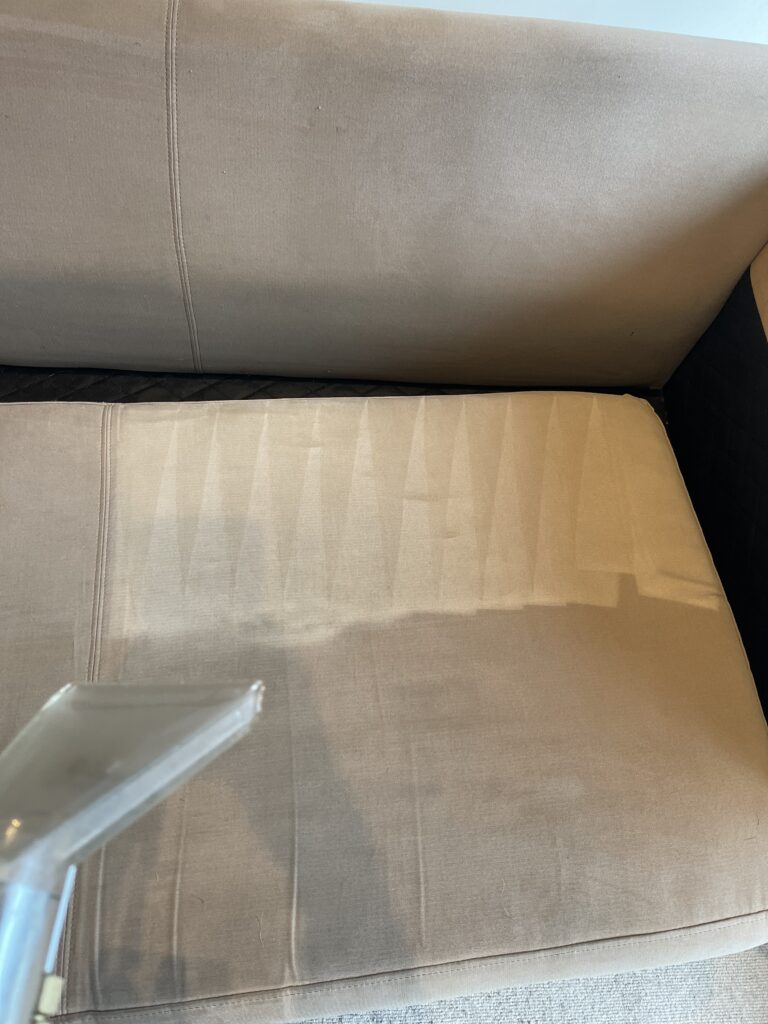
| W | Water-based cleaners are safe | Hot-water extraction (steam cleaning) after a fabric test |
| S | Solvent-based cleaners only, no water | Solvent or very low-moisture clean, careful spotting |
| W/S or SW | Either water or solvent cleaners | Method chosen to suit the soil, often hot-water extraction |
| X | Vacuum or light brushing only | Dry soil removal; wet cleaning is generally not advised |
W: water-safe fabrics
W-coded fabrics are usually synthetics such as polyester and many modern blends. They are the easiest to clean deeply. Even so, water should be controlled and extracted well. A W code does not mean you can soak the cushion.
S: solvent-only fabrics
S-coded fabrics include some viscose, rayon, natural fibres and fabrics with unstable dyes. Water can cause rings, browning or shrinkage. Household spray cleaners are mostly water-based, so DIY spot cleaning on an S fabric is a common way to create a bigger mark than the original spill.
W/S: the flexible option
W/S fabrics tolerate either approach. The cleaner can pick the method that best suits the stain or soil, for example a solvent for an oily mark and hot-water extraction for general grime.
X: vacuum only
X is the rarest and most restrictive code. The manufacturer is saying no water and no solvent. Professionals can still vacuum and brush out dry soil, which often improves appearance, but they should be honest that stains on X-coded fabric may not be treatable.
What if your sofa has no cleaning code?
A missing tag is common. In that case a professional should test a hidden area, such as the back of a skirt or the underside of a cushion. The test checks for colour bleed, shrinkage and how the fibres react to moisture and heat. FreshBreeze does a fabric test on every couch before cleaning, whether or not there is a code, because tags are sometimes wrong or the fabric has been replaced.
If the test shows the fabric is sensitive, a low-moisture method is the safer choice. Our comparison of couch steam cleaning vs dry cleaning explains the trade-offs between the two.
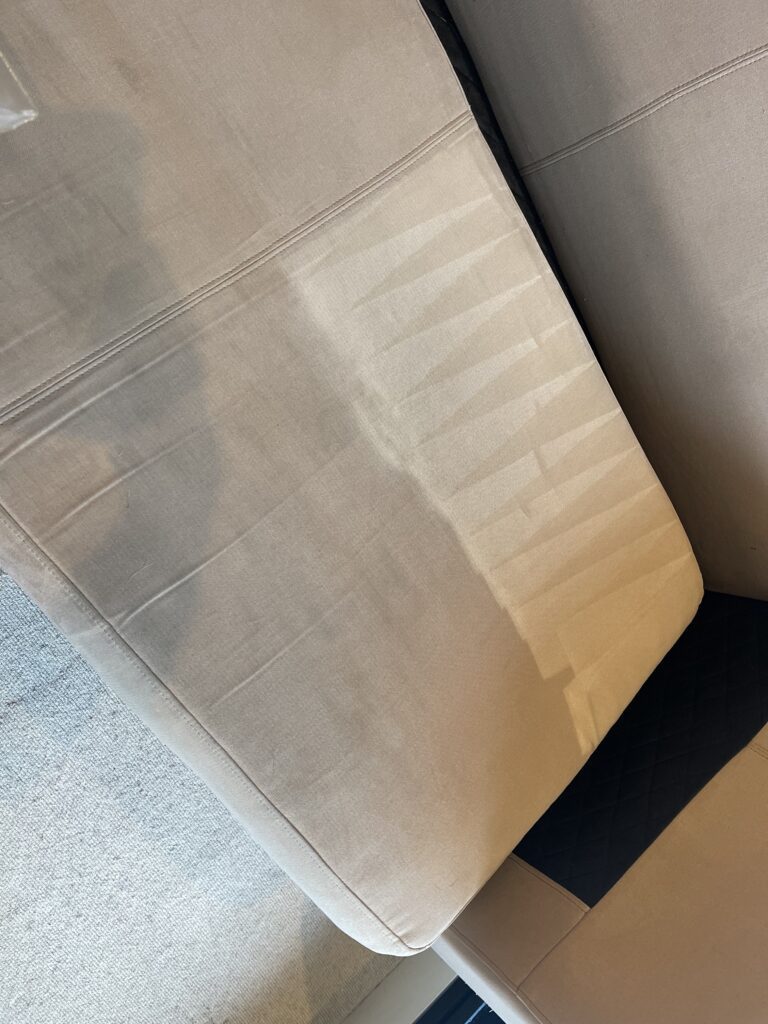
Why do water rings appear on the wrong fabric?
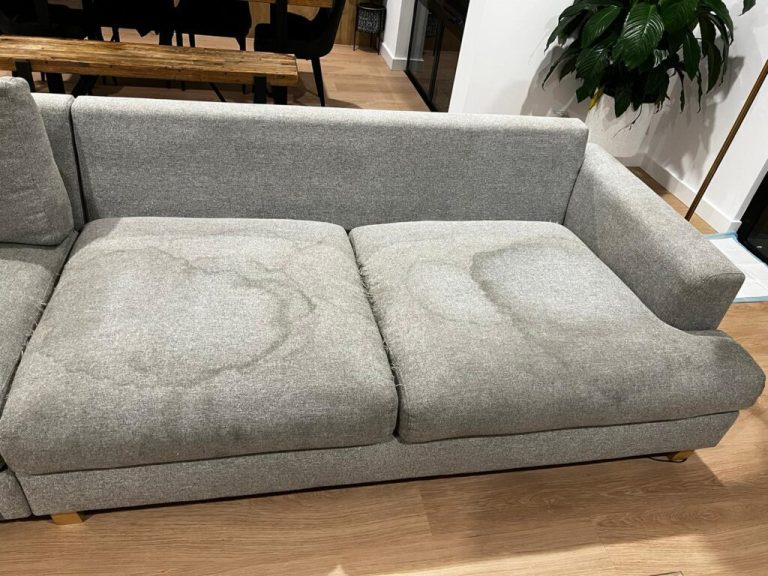
When too much water hits a sensitive fabric, it travels outwards and carries dissolved soil and sometimes dye with it. As the edge dries, that material is left behind as a visible ring. Natural fibres can also brown, a reaction called cellulosic browning. This is why a spot cleaned with a damp cloth on an S fabric often ends up looking worse.
If you already have rings on your cushions, read why water rings happen on couch cushions before trying to fix them, because more water is usually the wrong move.
Do cleaning codes apply to leather, curtains and mattresses?
Cleaning codes are mainly used for fabric upholstery. Other items have their own considerations:
- Leather needs a pH-balanced cleaner and conditioning rather than fabric cleaning methods. See leather couch cleaning and conditioning.
- Curtains often carry washing symbols instead. Many can be cleaned on site while hanging with a low-moisture method after a fabric test.
- Mattresses are cleaned with controlled moisture and HEPA vacuuming rather than by care code.
Spot cleaning safely before the professionals arrive
If you have a fresh spill and want to limit the damage while you wait for a clean, keep it simple:
- Blot with a clean white cloth. Do not rub, which spreads the stain and roughens the pile.
- Check the code before using any product.
- On W or W/S fabric, a small amount of cool water on the cloth is usually the safest first step.
- On S or X fabric, or if you are unsure, stop at blotting and leave it to a professional.
- Avoid bleach, vinegar mixes and carpet sprays, which can strip dye or leave residue.
Photograph the care tag with your phone when you buy a new couch. Tags fade and get cut off, and having the code on hand makes quoting and cleaning safer.
Getting upholstery cleaned in Melbourne
When you request a quote, send a photo of the couch, the care tag if there is one, and your suburb. FreshBreeze will confirm a fixed price before starting, test the fabric on the day, and choose the method that suits the code and the soil. Cushions are cleaned on both sides where they are removable, and there is a free re-clean guarantee if any area is not right.
To book professional couch and upholstery cleaning in Malvern or anywhere across Melbourne, text a photo to 0485 522 533 or call (03) 7067 9244. You can see how jobs are quoted on the pricing page.